

Table of Contents
TL;DR
A $1 million retirement goal is not automatically right for you. Someone spending $30,000 per year may need far less than someone spending $100,000, while Social Security, pensions, taxes, healthcare and retirement age all change the calculation. Start with expected annual spending, subtract dependable income and estimate the investment portfolio needed to fund the remaining gap.
How Much Net Worth Do You Actually Need to Retire Comfortably?
Why $1 Million Can Be Too Much or Too Little
The idea that everyone needs $1 million to retire sounds clear and memorable. It is also incomplete.
A retiree spending $30,000 per year has a very different financial requirement from a retiree spending $100,000 per year. Someone receiving Social Security and a pension needs less from investments than someone relying almost entirely on a portfolio. A person retiring at 52 needs assets to last longer than someone retiring at 68.
The better question is not, “Have I reached $1 million?” It is:
How much annual spending must my invested assets support after reliable income is counted?
There is another distinction many retirement targets miss. Total net worth includes home equity, vehicles, business ownership and other valuable assets. Retirement spending usually depends more directly on investable net worth: retirement accounts, brokerage investments, cash reserves and income-producing assets that can fund expenses.
A homeowner with a $1 million net worth may still have only $300,000 available for retirement spending when most of that wealth is tied to the home they intend to continue living in. Home equity matters, but it should not automatically be treated like an investment portfolio unless downsizing, selling or another access plan is realistic.
The Foundation: The 4% Withdrawal Rule
A common starting point for retirement planning is the 4% rule.
The approach begins with withdrawing 4% of an invested portfolio during the first retirement year, then adjusting that dollar withdrawal for inflation in later years. The Trinity Study examined historical outcomes for portfolios containing stocks and bonds. A later review published by the Financial Planning Association reported that an inflation-adjusted 4% starting withdrawal survived 95% of historical rolling 30-year periods for a 50% stock and 50% bond portfolio.
This is where the familiar calculation comes from:
Annual Portfolio-Funded Spending × 25 = Retirement Portfolio Target
If your portfolio must provide $40,000 per year, the simple 4% framework produces a starting target of $1 million.
But 4% is not a promise. Market returns, inflation, taxes, fees and spending changes affect outcomes. Morningstar’s 2025 retirement-income research estimated a 3.9% starting withdrawal rate for retirees seeking consistent inflation-adjusted spending over a 30-year retirement with a 90% probability of funds remaining at the end.
That small difference raises the target slightly:
Annual Portfolio-Funded Spending ÷ 0.039 = More Cautious 30-Year Portfolio Estimate
Use the 4% figure as a planning baseline, then stress-test your plan with a slightly lower withdrawal rate when you want more margin.
Retirement Portfolio Targets by Lifestyle Level
The following figures assume your portfolio must fund the full annual spending amount before taxes. They do not yet subtract Social Security, pension income or other dependable income sources.
| Retirement Lifestyle | Annual Spending | 4% Starting Target | 3.9% Starting Estimate |
| Lean retirement | $30,000 | $750,000 | $769,231 |
| Moderate retirement | $55,000 | $1,375,000 | $1,410,256 |
| Comfortable retirement | $80,000 | $2,000,000 | $2,051,282 |
| Affluent retirement | $120,000 | $3,000,000 | $3,076,923 |
Lean Retirement: $30,000 Per Year
A $30,000 annual spending plan produces a $750,000 portfolio target using the 4% framework. This may be possible for someone with low housing costs, modest transport needs and limited discretionary spending.
The risk is a thin margin. Healthcare, home repairs, helping family members or a sudden increase in rent can place pressure on a lean plan quickly. A low-spending retirement may work well, but only when the budget is realistic rather than optimistic.
Moderate Retirement: $55,000 Per Year
At $55,000 per year, the basic 4% target becomes $1.375 million. This level may support ordinary housing, transportation, healthcare, occasional travel and day-to-day comfort, depending on location and debt.
This is also where Social Security can make a major difference. A household does not necessarily need the full $1.375 million in investable assets when dependable income covers part of the spending need.
Comfortable Retirement: $80,000 Per Year
An $80,000 annual lifestyle requires a $2 million starting portfolio under the 4% framework before other income is considered.
This level generally demands years of consistent retirement saving, strong employer contributions, investment growth, reduced debt or a combination of these. It may also reflect a household that wants more travel, higher housing costs or room for larger healthcare and family expenses.
Affluent Retirement: $120,000 or More Per Year
A $120,000 annual spending plan requires a basic starting portfolio of $3 million before dependable income offsets the need.
At this level, tax planning becomes especially important. Withdrawals from traditional retirement accounts may be taxable, while taxable brokerage sales may create capital gains. The amount you need to withdraw can be greater than the amount you plan to spend.
How Social Security Can Reduce the Portfolio You Need
Retirement spending should be calculated after considering dependable income sources.
Suppose you expect annual retirement expenses of $55,000 and estimate $24,000 per year in Social Security income. Before considering taxes, your portfolio-funded gap is:
$55,000 − $24,000 = $31,000
Using the 4% framework:
$31,000 × 25 = $775,000
Using a 3.9% starting withdrawal estimate:
$31,000 ÷ 0.039 = approximately $794,872
That is a very different target from $1.375 million.
Do not guess your Social Security amount. The Social Security Administration provides benefit estimates based on your earnings record and planned claiming age through a personal Social Security account. Benefits can change depending on when you claim, and a spouse may have additional benefit considerations.
Pension income, annuity income, rental cash flow and part-time work can also reduce the amount a portfolio must provide. Count income conservatively and make sure it is dependable enough to support the plan.
Risk Factors That Can Raise Your Retirement Number
Retiring Early
The 4% framework is commonly discussed for a 30-year retirement. Someone leaving work at 50 may need assets to support spending for forty years or longer.
Rather than assuming a fixed 3.5% rule applies to every early retiree, use a lower withdrawal rate as a stress test, keep spending flexible and consider how healthcare and market downturns would be handled before Social Security and Medicare begin.
Inflation
A retirement budget stated in today’s dollars will not buy the same lifestyle decades from now.
At 2% annual inflation, $80,000 today becomes approximately $144,909 after 30 years. Retirement projections should either express expenses in today’s dollars while using inflation-adjusted returns, or increase future spending estimates for inflation. Mixing the two approaches can create misleading results.
Healthcare Before Medicare
Medicare generally begins at age 65, with earlier eligibility applying in certain disability or qualifying medical situations. Someone retiring before 65 may need coverage through a spouse’s employer plan, former employer benefits, private coverage or the Health Insurance Marketplace.
Do not rely on a universal monthly healthcare estimate. Premiums and out-of-pocket exposure vary based on household income, age, location, plan selection and subsidies. Price the coverage available to you and include premiums, deductibles and likely out-of-pocket costs in your retirement budget.
Taxes and Asset Type
A $1 million traditional 401(k) may not provide the same spendable amount as $1 million in qualified Roth assets because pretax retirement withdrawals are generally taxable. Likewise, a household with most of its net worth tied to a primary residence may need a housing strategy before that equity can fund retirement spending.
Your retirement target should be built around spendable and accessible resources, not only a headline net worth total.
Find Your Current Position
Once you estimate your personal retirement target, calculate what you already have.
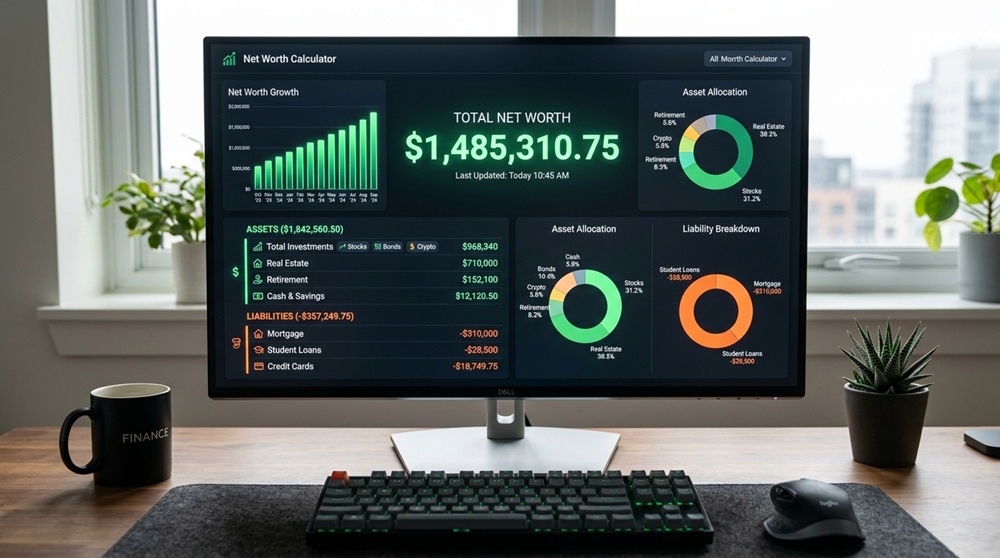
Include cash reserves, retirement accounts, brokerage investments, property equity and other meaningful assets. Subtract mortgages, credit cards, auto loans, student loans and remaining liabilities. You can see where you stand today by entering your assets and debts and reviewing your current net worth, debt ratio and asset breakdown.
The calculator measures your current position rather than producing a full retirement forecast. Use that baseline alongside your personal portfolio target.
For example, someone with a $775,000 retirement portfolio target and $325,000 in investable assets has a $450,000 gap before considering future growth and contributions. That gap helps shape the next decision: how much to save monthly, when to retire, how much spending to plan for and which debts should be reduced first.
For more practical guidance on assets, liabilities and long-term wealth tracking, visit NetlyWorth.
Know Your Number, Then Build Backward From It
Retirement comfort is not defined by reaching one universal dollar amount. It is defined by having enough reliable income and investable assets to support the life you plan to live.
Estimate annual spending, subtract dependable income, select a cautious withdrawal framework and calculate the portfolio gap. Then measure your current net worth honestly and keep building from there. The right retirement number is not the number repeated in headlines. It is the number based on your own expenses, income sources, timeline and margin for uncertainty.